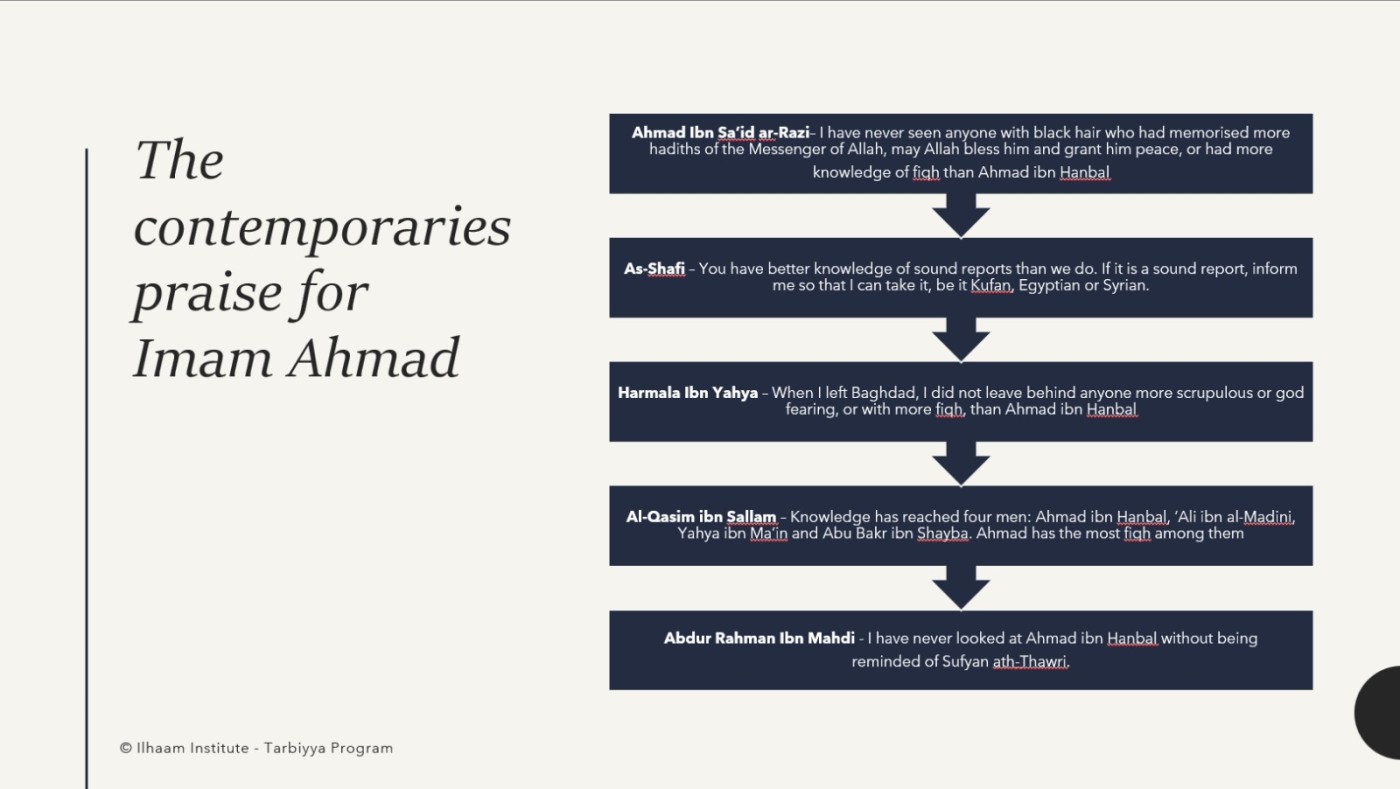
As part of our studies in the Tarbiyya Program, we discussed the noble biography of Imam Ahmad ibn Hanbal (rahimahullah). He was the last to pass away among the four illustrious Imams—founders of the well-known schools of fiqh.
We delved into his early life, beginning with his upbringing in Baghdad, followed by his pursuit of the noble sciences. In his early twenties, he travelled to distant lands such as Ḥijaz and Yemen, seeking knowledge from the scholars of his time.
Despite being raised in a city rich with diverse intellectual traditions—where he encountered linguists, theologians, and philosophers—Imam Ahmad (rahimahullah) made a conscious decision to dedicate himself to the sacred sciences, particularly hadith and fiqh. His deep love and commitment to the Sunnah of the Prophet ﷺ were well known.
Imam Ahmad (rahimahullah) endured many trials that served to purify himself when the worldly temptations presented themselves to him. None, however, were as a severe as the period of the Mihna (Inquisition). This trial stemmed from a theological dispute on the nature of the Quran, particularly between the Muhaddithun (Traditionalists) and the Mu’tazilah (Rationalists) which spilled into government policy. Al-Ma’mun tested him with injury, Al-Mu’tasim tested him with imprisonment, Al-Wasiq with restrictions, and even after the Mihna ended, Al-Mutawakil tested him with luxury. Imam Ahmad (rahimahullah) remained steadfast throughout, rejecting all these trials out of fear of Allah.
We also examined the historical and theological implications during this period, discussing how these doctrinal shifts affected both society and Islamic thought.
And Allah knows best.

 Ilhaam Institute
Leave a comment