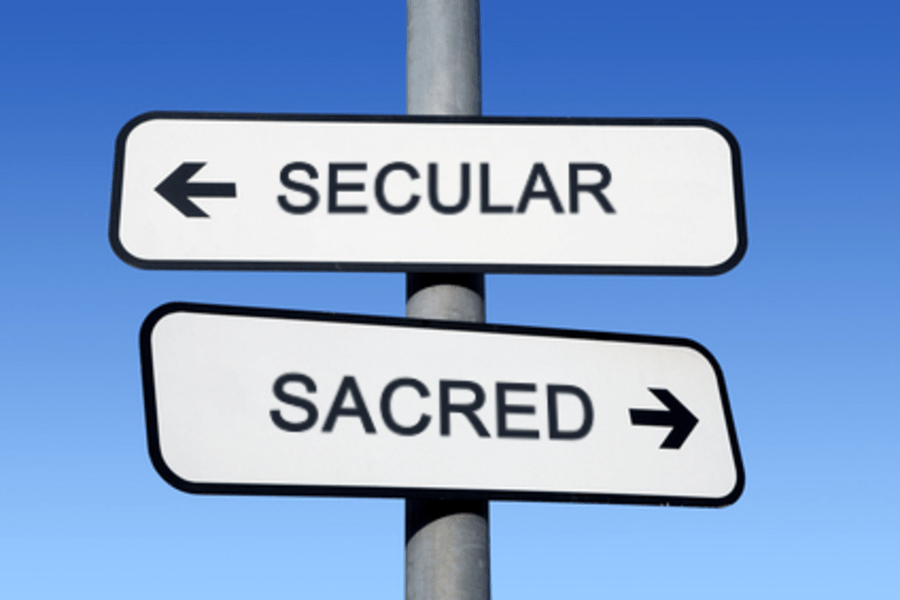
This series, Philosophical Crossroads, aims to introduce the dominant philosophies shaping the Western world today by tracing their historical roots, unpacking their core principles, and critiquing their impact on our everyday lives. By juxtaposing these ideologies with Islamic perspectives, the series seeks to explore where they align, where they diverge, and how they might be reimagined in light of Islamic moral and ethical principles.
Through this exploration, readers are invited to view these philosophies not as abstract concepts but as forces that deeply influence modern life. Understanding these “isms” is essential for tackling their inherent assumptions and offering a comprehensive Islamic framework—a more meaningful and unified alternative to the fragmented visions of society we see today.
The series begins with secularism, examining its core idea of separating religion from the state and its portrayal of neutrality as the pinnacle of progress.
Birth & Definition
Secularism is an ideology in both philosophy and politics, that seeks to separate religion (religious institutions) from the affairs of the state. Jean Bauberot [1], the prominent French secularist, defines it as:
- Separation of religious institutions of the state, ensuring no domination of the political sphere by religious institutions.
- Freedom of thought, conscience, and religion for all, with everyone free to change their beliefs and manifest their beliefs within the limits of public order and the rights of others.
- No state discrimination against anyone on the grounds of their religion or non-religious world view, with everyone receiving equal treatment on these grounds.
Secularism’s roots lie in the Enlightenment era, when extreme and dangerous religious dogmas and theocratic systems, prompted thinkers to challenge their authority. Subsequent reforms of the Church and progression of the natural sciences led to further challenges to the role of religion in a future society. Secularism was one such answer to ‘liberate’ governance and the public image from the divisive damage seen in Europe prior to the age of Enlightenment during the 17th and 18th centuries.
Secularism is not an abstract, static concept confined only to the political and neutral lens, but as an ever-evolving form since its inception. Charles Taylor [2] argues that this can be seen in three distinctions/phases:
- Secular1 – Separating the sacred affairs and the worldly affairs. A clear distinction was evident in the roles and responsibilities: for example, the clergy fulfilled the sacred responsibilities, while farmers and merchants would focus on worldly affairs. It is important to note that Secular1 does not imply the absence of religion but rather division amongst the community.
- Secular2 – This embodies the idea of neutrality and suppression of religious influence in public governance. This principle can be found in most countries today, with France being the most known example today – where the state maintains an impartial stance towards all religions (theoretically speaking)
- Secular3 – The most transformative paradigm – which represents a change in the ‘conditions of belief’. What this means is that belief in God and the terms of believing in him are considered as one of many options. Faith is now akin to a marketplace, competing with other ideologues – a result of cultural and social frameworks shaping contemporary beliefs.
Charles Taylor [3] further highlights other shifts in worldview points, such as the rise of humanism. He describes this perspective where meaning and joy is found entirely within the material corporal world, without recognition of the divine nature of God. This represents a departure from pre-modern societies, where belief in God was integral to living their daily lives. This subtraction of religion is replaced with an alternative moral framework that excludes divine nature.
Talal Asad [4] further expands that the secular framework is continuously developing through blurring the lines between religious and secular boundaries, often through power structures of the modern state. Asad states that the state plays a central role in religion, determining what qualifies as religious expression and what level of religion can manifest in private or public spheres.
An example of this can be seen in the use of laïcité within French society, which strictly enforces the separation of religion and public life. While the law states this is to uphold equality and neutrality, it disproportionally affects minority groups’ capacity to practice their religion, especially Muslims. As a result of the 2004 ban [5] on displaying religious symbols in schools – including the hijab – this law dictates under the guise of neutrality to conformity as per the state’s desire. Advertently, they impose their own values and assumptions. This should raise critical questions about whether secularism is pluralist or, in practice, merely replacing one ideology with another.
Myth of Neutrality
Continuing about neutrality, the claim of purported impartiality is a myth. Secularism assumes that the absence of religious influence equates to fairness yet promotes its own framework – initially emerging from the perception of religion as antagonistic to science, rationality and morality [6]. In fact, can neutrality be reached if there is no neutral principle of irreconcilable authority? Can tolerance be drawn without someone drawing it? Stanley Fish illustrates an example of such below [7]:
Take Person A who believes fairness might be the distribution of goods and privileges equally, irrespective of the accomplishments of those who receive them. Meanwhile, Person B holds that it is only fair to reward each according to their efforts. The first approach can be considered egalitarian, the second is meritocratic. Now, we cannot resolve this dispute simply be the invocation of fairness because, “what divides us are our differing views of what fairness really is.” Who ultimately determines the principles by which one is deemed right or wrong, or at least better than the other? This example can apply to other values, such as quality, justice, autonomy.
As a result, the practice of neutrality within the private sector – emphasises individual autonomy at the expense of communal practice within our daily lives. By confining religion to the private sphere at home, it reduces faith to a personal choice rather than a holistic framework that informs every aspect of their existence. As a result, this reductionist approach limits religion in shaping public discourse openly.
Islamic Perspective
Touching briefly on the Islamic perspective, the fundamental flaw lies in the exclusion of God from public life. Islam offers an ubiquitous worldview that integrates the spiritual and the material, recognizing the interconnected nature of God and creation. Islam views religion and governance as complementary, with guidance from the Almighty seen as the foundation of justice, equity and human flourishing.
The reductionist approach, which confines religion to the private sphere, is critiqued by Islam –emphasizing a balance in this life between the spiritual and the material. Furthermore, the unhealthy overemphasis on individual autonomy undermines the collective well-being, disregarding the transcendental principles of ethics and morality upheld by Islam. Allah states in the Quran [4:135]:
يَـٰٓأَيُّهَا ٱلَّذِينَ ءَامَنُوا۟ كُونُوا۟ قَوَّٰمِينَ بِٱلْقِسْطِ شُهَدَآءَ لِلَّهِ وَلَوْ عَلَىٰٓ أَنفُسِكُمْ أَوِ ٱلْوَٰلِدَيْنِ وَٱلْأَقْرَبِينَ ۚ إِن يَكُنْ غَنِيًّا أَوْ فَقِيرًۭا فَٱللَّهُ أَوْلَىٰ بِهِمَا
فَلَا تَتَّبِعُوا۟ ٱلْهَوَىٰٓ أَن تَعْدِلُوا۟ ۚ وَإِن تَلْوُۥٓا۟ أَوْ تُعْرِضُوا۟ فَإِنَّ ٱللَّهَ كَانَ بِمَا تَعْمَلُونَ خَبِيرًۭا
O believers! Stand firm for justice as witnesses for Allah even if it is against yourselves, your parents, or close relatives. Be they rich or poor, Allah is best to ensure their interests. So do not let your desires cause you to deviate ˹from justice˺. If you distort the testimony or refuse to give it, then ˹know that˺ Allah is certainly All-Aware of what you do.
Charles Taylor [8] touches on the ‘Malaise of Immanence’ – the emptiness that arises from the exclusion of transcendence. As a byproduct of modern progress, human fulfilment becomes limited, with purpose reduced to serving the material world. Allah addresses this by rooting human existence in a divine purpose. The Quran describes the role of believers as stewards on the Earth, responsible for worshipping Allah and upholding justice in their lives [2:30]:
وَإِذْ قَالَ رَبُّكَ لِلْمَلَـٰٓئِكَةِ إِنِّى جَاعِلٌۭ فِى ٱلْأَرْضِ خَلِيفَةًۭ ۖ قَالُوٓا۟ أَتَجْعَلُ فِيهَا مَن يُفْسِدُ فِيهَا وَيَسْفِكُ ٱلدِّمَآءَ وَنَحْنُ نُسَبِّحُ بِحَمْدِكَ وَنُقَدِّسُ لَكَ ۖ قَالَ إِنِّىٓ أَعْلَمُ مَا لَا تَعْلَمُونَ
˹Remember˺ when your Lord said to the angels, “I am going to place a successive ˹human˺ authority on earth.” They asked ˹Allah˺, “Will You place in it someone who will spread corruption there and shed blood while we glorify Your praises and proclaim Your holiness?” Allah responded, “I know what you do not know.”
Conclusion
Secularism has greatly influenced modern governance and culture today. Societal habits have been reshaped, religions are now presented as an option, and rationality is promoted as the ultimate truth above all else – despite failing to deliver upon its own principles.
The French model of secularism starkly showcased the limitations of secularism, exposing its inability to accommodate genuine diversity and its inclination to impose a singular worldview on its people. While secularism offers some valuable elements, its severe shortcomings highlight the need for a framework that integrates both the material and the spiritual. Islam offers such an alternative, balancing personal freedom with collective understanding and accommodating the complexities of modern life. This is built upon principles of responsibility, justice, morality and accountability across all of society.
As we critically engage with secularism and the other “isms”, we are invited to reflect on their assumptions and explore the timeless relevance of the Islamic paradigm in address the pressing challenges we face today.
To conclude, I quote the words of Hallaq [9], who summarises the lasting imprint of secularism:
‘Let us remember what secularism is. Secularism is not just segregating religious life into the private sphere. It is rather the determination of the state of what religion is and is not, where and how it can be exercised. In terms of political theology, secularism is the murder of God by the State. The state can delimit, limit, exclude or curtail any religious practice, and thus has the power to determine the quality and quantity of the religious sphere as it sees fit.’
- Baubérot, Jean. (2010) ‘The Evolution of Secularism in France: Between Two Civil Religions’, in Cady, L.E. and Hurd, E.S. (eds.) Comparative Secularisms in a Global Age. New York: Palgrave Macmillan.
- Taylor, Charles. (2018) A Secular Age. Cambridge, MA: Harvard University Press, pp. 437–441.
- Ibid, pp 660-665.
- Asad, Talal. (2003). Formations of the Secular: Christianity, Islam, Modernity. Stanford University Press, p.17.
- The Guardian (2024). Ban on headscarves in France: secularism, exclusion, and intolerance.
- Cavanaugh, W.T. (2009). The Myth of Religious Violence: Secular Ideology and the Roots of Modern Conflict. Oxford University Press. p. 59.
- MacIntyre, Alasdair. (1988). Whose Justice? Which Rationality? Notre Dame, IN: University of Notre Dame Press, p. 8.
- Taylor, Charles. (2018) A Secular Age. Cambridge, MA: Harvard University Press, p. 224.
- Hallaq, W. B. (2021). Wael B. Hallaq on Islamic Law and Human Rights. Daily Philosophy. Available at: https://daily-philosophy.com/interview-wael-hallaq-islamic-law/

 Ilhaam Institute
Leave a comment