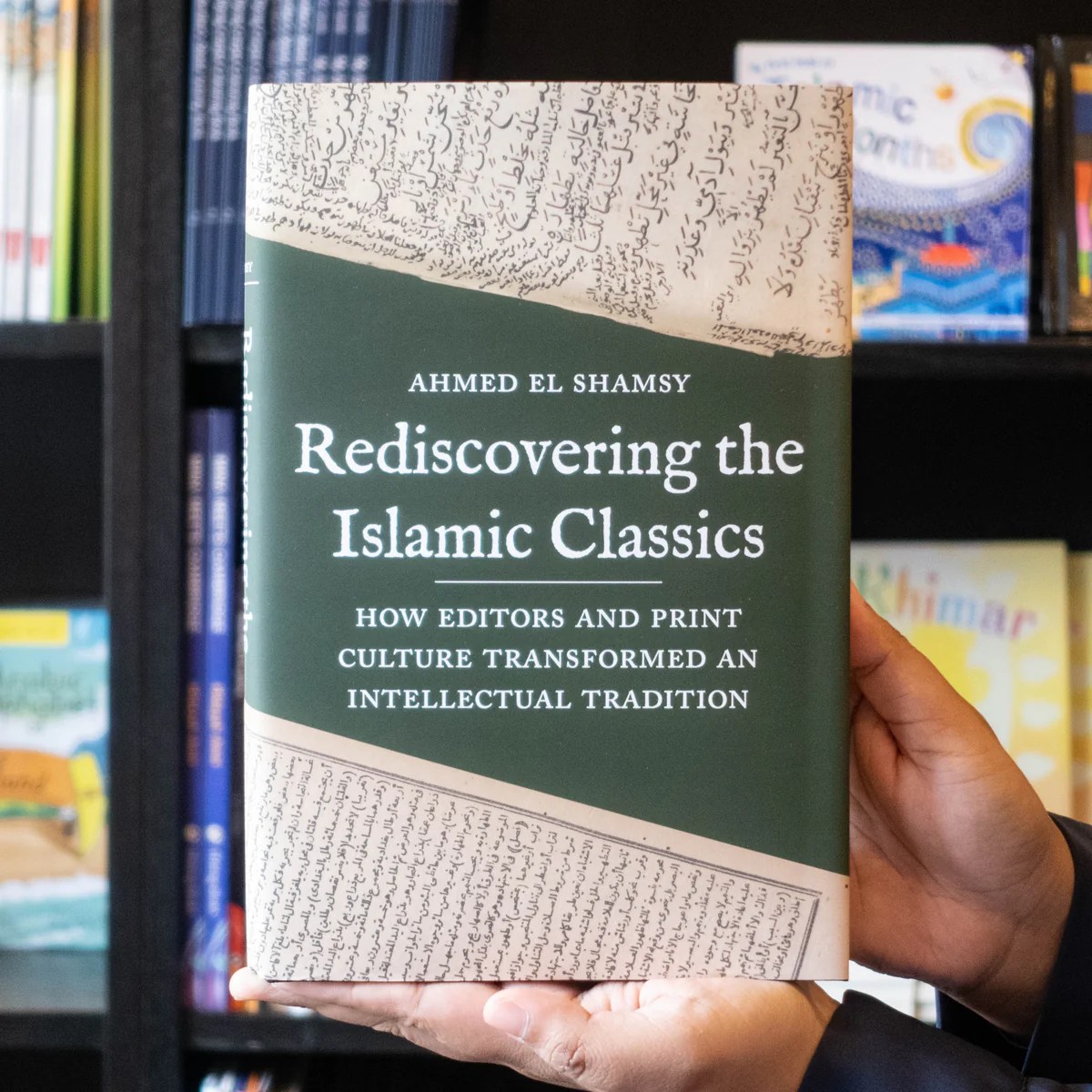
Ahmad El Shamsy latest book, Rediscovering the Islamic Classics: How editors and print culture transformed an intellectual tradition, published in 2020 delves into the impact of the printing press across the Arab world (with particular focus on Egypt) that led to a revival in classical Islamic scholarship. This shift breathed life into many original works that were considered to be lost, confined to manuscripts that had been gathering dust. Shamsy’s book is an excellent overview of Islamic historicity and invites as readers to rethink the notion of what truly defines an Islamic classic!
The book begins with depicting the state of Islamic literature from the 15th century onwards. During this period, there was a drain of original Islamic works by Europe – for example, the Bavarian State Library purchased some 1,250 manuscripts and 30,000 books in 1858, financing such an acquisition by selling its copy of the Gutenberg Bible. Shamsy also makes note to the mismanagement of libraries and declining scholarship painting a bleak reality at that time. He does this illustration best noting that the library of Mahmudiyah, which housed over 4000 books during the time of Suyuti (who died in 1505), had diminished to just 58 by the end of the 19th century.
Further inquisition reveals that many ‘classical’ books were in fact commentaries or summaries of those classical books. These texts reduced the original books to just a few words within these manuscripts. Scholars then in the post-classical era built upon these commentaries, rending the original texts inaccessible and in many cases lost. Shamsy discusses how the rise of certain Sufi sects led to a shift away from traditional epistemological book learning, stressing the authority of spiritual leaders instead. One critique I have of this chapter, was that Shamsy skimmed over the shift away from central texts quickly. It would have been beneficial to provide greater context over the larger impact on certain regions and may leave those readers unfamiliar with these groups and their impact, somewhat in the dark due to the lack of depth. This digression admittedly, would have strengthened Shamsy’s argument as to why the original texts became redundant as they did.
The next two chapters highlights the expansion of the publishing industry, fuelled by renewed zeal and determination. Shamsy showcases some of these individuals who seized the opportunity to preserve the heritage of the past millennium. The author takes us through a timeline, emphasizing crucial figures like Nafi and Taymur, who were key in arresting some of the decline or spread of secularism and liberalism by protecting the classical literature that forms the foundation of the religion. This new ‘generation of book lovers’, many of whom are wealthy and well-connected investors, began the process of safeguarding and reclamation of stolen manuscripts.
In chapters 5 & 6, Shamsy begins with discussing the impact of Ahmad Zaki Pasha, who played a crucial role in addressing the next phase of preservation, following the difficulty in securing manuscripts and managing printing costs. Ahmad shaped the role of the editor (Muhaqqiq), combining his deep traditional scholarship and bureaucracy to bring the works of old into the new. As the potential of the printing press began to unfold, figures like Muhammad Abduh saw it as a golden opportunity to revatlize specifically the Arabic language. This effort from Muhammad Abduh and others marked the beginning of a vibrant Islamic book culture to spread.
The penultimate chapter sees Shamsy explore how the scholarly class (Ulema) focused their efforts on locating specific publications and reviving the works of certain scholars. He highlights the example of the ‘Salafis’, who sought to revive the writings of Ibn Taymiyyah, who is seen as a countermeasure against the Sufi beliefs that they felt was one of the primary reasons for the Islamic decline and to address the challenges of the 20th century. This revivalist approach extended across various denominations, theologically and jurisprudentially with each aiming to bring back the works of certain scholars. Shamsy examines this focus through two scholars in Al-Alusi and Al-Qasimi.
In the final chapter, the author shifts his attention to the development of textual criticism. As the volume of printed material grew, there arose a need to protect the authenticity of classical texts and maintain acceptable standards of printing. Shamsy focuses on two methodologies that conflicted: one advocating for the adoption of the western standard and the other to create a unique standard for the Islamic corpus based on existing standards. Suffice to say, this argument continues to echo in other capacities in mosque circles today.
To conclude, I felt Shamsy underlines that the adoption and overhaul of Islamic literature was from a robotic process – it represented an intellectual shift that reshaped the entire paradigm within the Islamic world. He does an effective job at introducing this transformative process, shedding light to the individuals who shaped the texts we now cherish in our libraries today. Personally, it encouraged me to reflect on how we can tackle the areas of decline we see in the Muslim world today. Now honestly, the topic may not catch the eye of every reader (it certainly wasn’t on my radar), but I would genuinely recommend this work as one to explore, even for those who are just casually interested.

 Ilhaam Institute
Leave a comment