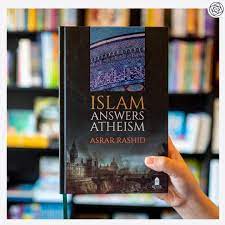
Asrar Rashid, a well-known teacher of Islamic sciences and debater who tackles religious and theological issues with various groups in the UK published his first book in 2021 titled: Islam Answers Atheism. Known for confronting difficult topics or opponents, this book was born out of much experience and research and written predominantly during the covid period. Islam Answers Atheism in short is a well written work which is a good resource for Muslims to understand answers to atheistic criticism and learning about the role of theology when critiquing atheistic ideas. The writer’s knowledge of sociological, geopolitical, and western philosophical issues in particular standout as he points to the hypocrisy on new-atheism ideas – a political repackaging of the same notions a century ago.
The book is divided into 6 chapters, which can be focused in two main areas. Section 1 sees Asrar Rashid layout the Islamic theological framework and the basis for such framework. This is predominantly based on his creedal background which is Asharism which he in turn, then uses to address the theological and philosophical arguments made by atheists based on God, his attributes, and his will. This section serves as the strength of the book, with Asrar taking considerable effort to discuss the framework at length and serving to use it as his argument in the following chapters when countering the atheist narrative on God and presenting the Ashari counternarrative to these. Asrar Rashid strove to try and include all the modern-day arguments presented by new atheists, which is commendable, but some of these counter arguments not well presented or refuted. It may have been better to focus on fewer arguments and go explore them further, rather than covering many arguments superficially. The referencing also varies considerably in quality and for different arguments. This would be an essential area of improvement for a potential revised edition.
A brief look at the book sees chapter 1 provide a general overview of Islam and new atheism and the evolution of kalam and theology in Islam. Chapter 2 expounds on the epistemology of Kalam in a copious amount of detail. Issues such as certainty, empiricism and proof are examined at length, with this chapter serving as the strength of the book.
Chapter 3 & 4 apply the framework established in chapter 2 to address the philosophical and theological questions raised by new atheist’s today. Some of these questions include:
- God’s existence
- Russel’s Teapot
- Cantor’s Set theory
- Continuous Regression
- Causal principle
- Names and Attributes of God
- Theological Contentions
- The Problem of Evil
- The question of divine knowledge
- Human Free-will
- Sin and Hell
Most of these questions are answered adequately to inform the reader of the fallacies of these questions and how to begin to respond to them. As mentioned above, some are articulated better than others with most serving as preliminary answers to subjects that are of multi-centurial debate within Islam.
The last 2 chapters examine how to use this framework to respond to the new atheists scientific, ethical, and moral challenges to the Quran and Sunnah. Topics included the alleged conflict between Islam and science, Miracles (The Buraq, Splitting of the Moon), as well as tackling headlines in the news such as Jihad, Polygamy, Slavery etc…
In summary, despite some weaknesses in the book, some of which are mentioned above as well as some kalam arguments and vague postulations raised being unsatisfactorily explained, the book is well written and address the arguments and challenges that UK Muslims face from the wave of new atheism. This book fills some of the gap in literature that is needed to counter the naturalistic worldview that is dominated in the English-speaking world with very few works currently available. The Divine Reality (Hamza Tzortis) and the works of Sapience Institute in the UK are the few I know actively in the field. This book is a good resource for all Muslims, whether they are familiar with these topics or not. A good work that one should take the time to read and take from.

 Ilhaam Institute
Leave a comment